

Ten-ish years ago, I was walking around Neiman Marcus on a trip to Oahu.
I grew up in a small city in western Canada. The closest my local mall got to “real” fashion was the now defunct Hudson’s Bay (RIP). As a fashion-obsessed teenager with cutouts from Vogue all over her bedroom wall, this was very exciting. It was always a goal of mine to start a clothing brand since I was 12. I didn’t go to fashion school - my parents said “no way, way too expensive, better to get a real job.”
I took an accounting course and began working as a bookkeeper. But I found myself with a little extra time on my hands in the evenings. The dream hadn’t died (I want to know: does it ever? For anyone else?)
Thankfully, there was the university of YouTube, and I enrolled when I turned 22.
I figured this wasn’t like becoming a doctor or lawyer. I didn’t need a degree. I just wanted to make clothes, surely I could learn using just the sewing machine and serger I saved all summer for when I was 16.
I went to the Parsons and FIT student resources page and saw what textbooks the students needed for the patternmaking class and ordered them. I wasn’t sure where I wanted to take this, but the goal was simple: to make clothes that someone would actually want to wear.
I didn’t feel qualified, but my desire and ambition outweighed my imposter syndrome (most of the time).
I fell absolutely in love with patternmaking and fabrics and slowly, over the course of a few years, went ahead and created my first silk collection of six dresses. (Funnily enough, they were all silk, though I hadn’t yet consciously chosen to be a silk brand at that point.) I guess the beauty and feeling of silk always attracted me.
It was incredibly labour intensive, with linings and zippers attached by hand, a 5 yard heavy silk crepe skirt on one of the dresses, hand rolled hems. I would describe it as “amateur couture level” (shoutout to the Susan Khalje couture sewing school). I was beyond proud of what I had created with no formal schooling.
I reached out to a local photographer and did my very first professional photoshoot. I will never forget the high I felt seeing my hard work come to life for the first time.
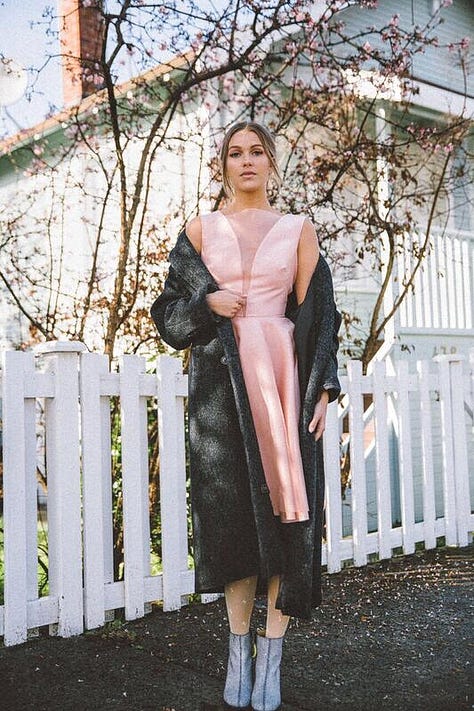

*Still so proud of this very first collection
But there was a disconnect.
It took awhile to admit to myself that I wouldn’t personally wear what I had created. While this works for many designers who you find in a black t-shirt every day of the week while creating elaborate, time-intensive couture garments, it didn’t feel true to me, and this mattered to me.
It took a few months to “marinate” as I like to call it. I went inward, examining what about it didn’t sit right. I loved the act of creating each piece, but I knew I wanted to personally love and wear what I put into the world.
I was scrolling on the couch one day when I came across a textbook on draping. I was curious.
“I’ll give that a try.”
I pressed the Order button and didn’t give it much further thought. When it arrived, I began flipping through it.
It was an unlock to a whole new world. I immediately found a large square of fabric and began pinning it on my dress form.
The fabric came alive to me.

*Me working out of our old tiny 2 bedroom apartment. We had a king mattress in there for guests that I remember leaning against the wall to make room for sewing and cutting.
It was as if I was discovering language for the first time, a way of communicating that felt both incredibly foreign to me but also inevitable, as if I was born to learn this.
This was the breakthrough I had been waiting for. The bias cut spoke to me in a way that no previous patternmaking method had. I scoured the internet for silk charmeuse (now a Jacoba Jane signature) and began creating my second collection.
This collection felt different. I flashed back to my trip to Neiman Marcus, recalling many of the different fabrics I had touched in the store and the different construction techniques.
“There are a lot of clothes in the world already, how are mine going to be different?”
Brands always talk about quality. After all, you never see on an About page “We make cheap junk.” And indeed there are many, many brands creating very beautiful clothing. But what does quality mean to me, personally?
I knew I wanted to work with silk, but I concluded that I wanted to bring meaning and substance to what I create by using higher than normal silk weights. The 5 yard heavy silk crepe skirt from my very first collection came back to me, how different it felt in my hands compared to anything I had felt in a department store.
This is what matters to me.
Many women have never been taught to read a fabric the way previous generations could. Our grandmothers knew the difference between a good wool and a thin one. They understood thread count in sheets. They held garments up to the light and made decisions based on density, not branding.
Somewhere along the way, we stopped asking what things are made of in a tactile sense. We learned to read price and aesthetic, not substance. And substance matters, especially in silk.
Silk is often romanticized as delicate. But historically, it was prized precisely because it is very strong. A high-quality silk, woven densely, is incredibly durable. It can endure decades. It can be tailored.
Lower weight silk fabrics are not inherently “bad.” They are simply designed for a different purpose than mine: lower cost, lighter hand-feel, higher volume production. But when a dress is cut on the bias, as ours are, weight becomes even more important.
The bias cut relies on gravity. It relies on the fabric’s ability to fall along the body with the perfect amount of tension and control. A heavier silk allows the bias to do what it was meant to do.
This is why fabric is always our first design decision, before silhouette or color story or price. Higher weight silk costs more. It is substantially more expensive to source.
But there is a special kind of satisfaction in creating something with substance in a culture that increasingly rewards the opposite.
When women write to us saying, “You don’t find fabric like this anymore,” what they are often responding to is the weight. We are not interested in making many different types of things, we only want to create a collection of silk pieces very well.
We’ve come a long way since that very first collection, and we're so grateful that you're here.